

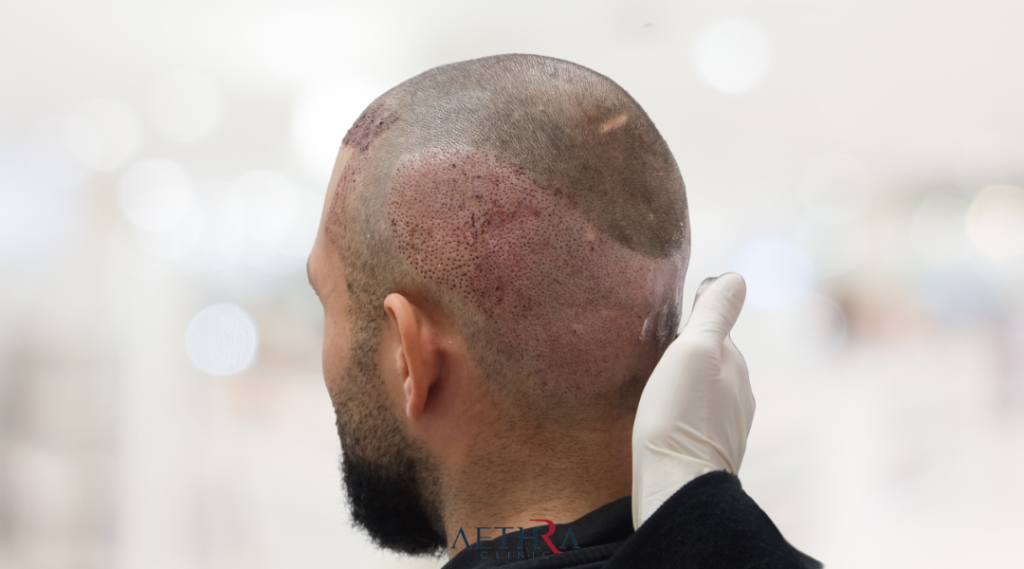
The First 7–12 Days After a Hair Transplant: Why Healing, Washing and Medical Follow-Up Matter
Hair Transplant Aftercare the first days after a hair transplant are not just a waiting period. They are one of the most important medical phases of the entire hair restoration journey.
Many patients believe that the operation day is the main event. In reality, the first 7 to 12 days after a hair transplant often determine how smoothly the scalp heals, how confidently the patient recovers, and how early complications can be prevented or managed.
During this period, the scalp is healing thousands of micro-incisions, stabilizing newly implanted grafts, managing inflammation, forming scabs, and rebuilding the skin barrier. This is also the time when patients are most likely to make mistakes: washing too aggressively, touching the grafts, picking scabs, sleeping incorrectly, sweating too early, or ignoring warning signs because they do not want to disturb the clinic.
That is why a doctor-led hair transplant clinic should treat the first 7–12 days as part of the procedure itself, not as an afterthought.
At Aethra Clinic, this period is considered a critical medical follow-up phase. The clinic’s approach is built around doctor-performed Sapphire FUE hair transplant, controlled aftercare, donor area protection, natural healing, and continuous post-operative guidance for patients from Slovakia, Europe and other international regions.
Table of Contents
What Happens During the First 7–12 Days After a Hair Transplant?
A hair transplant is a controlled medical procedure. Even when it is performed carefully, the scalp still goes through a natural wound-healing process.
In the first days, the body is working to close micro-incisions, protect the grafts and calm the skin. This healing process usually follows three main phases:
Day 1–3: Inflammation phase
Mild swelling, redness, tenderness, crust formation and sensitivity can be expected.
Day 3–10: Proliferation phase
The skin begins to seal, scabs mature, and the grafts become more stable in their new channels.
Day 10 and after: Early remodeling phase
The scalp usually looks calmer, scabs begin to clear, and the transplanted area starts to feel less fragile.
During the first week, the grafts are not completely loose, but they are also not fully stabilized. A gentle wash does not usually remove grafts, but rubbing, scratching, hot water, high-pressure showering or panic-driven overcleaning can irritate the scalp and disturb healing.
This is why proper guidance from the operating doctor is so important.
What Is Normal After a Hair Transplant?
Some discomfort after a hair transplant is completely normal. The goal is not to feel perfect immediately. The goal is to heal safely and predictably.
Common and usually normal signs include:
- Mild oozing during the first 24–48 hours
- Tightness in the donor area
- Itching, especially around Day 4–6
- Redness in the recipient area
- Swelling around the scalp or forehead
- Scab and crust formation around the implanted grafts
- Mild tenderness in the donor area
These signs are generally part of the normal healing process. However, the important point is that symptoms should gradually improve, not become worse.
Hair Transplant Complication Awareness
The first 7–12 days after a hair transplant are also important because early complications can usually be managed more easily when they are recognized quickly.
Patients should contact their doctor if they notice:
- Increasing pain after Day 3
- Pus-like discharge
- Bad smell from the scalp
- Rapidly worsening redness
- Fever or chills
- A localized hot, swollen or painful area
- Severe burning after applying a product
- Hives or allergic-type rash
- Bleeding that does not stop with gentle pressure
- One-sided swelling around the eye with increasing pressure
This does not mean every symptom is dangerous. But it does mean the patient should not be left alone with uncertainty.
Aethra Clinic’s follow-up model is important here because the same doctor who performs the operation also manages the post-operative process. This reduces the risk of generic advice and helps patients receive guidance that matches their actual scalp condition.
Hair Transplant Washing Guide
Washing after a hair transplant is one of the subjects patients fear most. Many patients worry that washing will remove the grafts.
In reality, when done correctly, washing helps the healing process.
The purpose of washing is not only cleaning. It is also:
- Medical hygiene
- Scab control
- Inflammation reduction
- Prevention of hard crust formation
- Comfort during healing
The real risk is usually not gentle washing. The bigger risk is allowing thick crusts to become too hard, which may increase itching, irritation and scratching.
General Washing Rules After a Hair Transplant
During the first 7–12 days, patients should follow several basic washing principles:
- Do not use high-pressure water directly on the grafts
- Do not rub the recipient area
- Do not use fingernails
- Do not scratch the scalp
- Use warm water, not hot water
- Pat-dry gently instead of dragging a towel
- Use only products approved by the medical team
- Follow the washing schedule given by the doctor
Every scalp is different. That is why washing instructions should always be adjusted according to the patient’s healing condition.
Day-by-Day Washing Approach After Hair Transplant
Although every clinic may have its own protocol, a structured post-operative washing rhythm usually follows a similar pattern.
Day 1–3: Protection and Gentle Care
During the first days, the recipient area should be protected. If the doctor recommends a foam, lotion or solution, it should be applied gently and rinsed without pressure.
The goal is not to clean aggressively. The goal is to keep the scalp calm and protected.
Day 4–7: Regular Washing Begins
Around this period, washing usually becomes more regular. A mild cleanser or foam may be used for a short contact time, followed by a gentle rinse.
At this stage, itching may increase, but scratching must be avoided.
Day 8–12: Scabs Begin to Loosen
By this stage, scabs usually begin to soften and loosen naturally. Patients may feel more confident, but aggressive rubbing is still not recommended.
If scabs remain thick and attached beyond this period, the safest approach is not force. The doctor should guide the next step.
Scab Management After Hair Transplant
No. Scabs should not be picked.
Scabs act like a temporary natural dressing. Removing them too early may:
- Irritate the skin
- Trigger bleeding
- Increase redness
- Pull on a graft that is still stabilizing
- Delay healing
The goal is not to remove scabs by force. The goal is to soften them through regular washing so they can release naturally.
Most scabs are expected to clear around Day 10–12 with proper care. If they do not, medical guidance is safer than aggressive self-cleaning.
Swelling After Hair Transplant
Swelling is common after a hair transplant, especially around Day 2–4. It can sometimes move from the scalp toward the forehead or around the eyes.
To reduce swelling, patients are usually advised to:
- Sleep with the head slightly elevated
- Avoid bending forward for long periods
- Stay hydrated
- Avoid alcohol during the early period
- Avoid very salty meals
- Avoid heavy exercise and heat exposure
Patients should not apply ice directly on the recipient area unless specifically instructed by their doctor.
Donor Area Healing
Most patients focus on the transplanted area, but the donor area is equally important.
The donor area is a limited resource. Once grafts are removed, they cannot be replaced. For this reason, donor area protection is one of the most important principles of a high-quality hair transplant.
In the first 7–12 days, donor healing usually progresses from tenderness to tightness, dryness and then calmer skin.
Patients should contact their doctor if the donor area becomes increasingly painful, hot, swollen, wet or irritated.
At Aethra Clinic, donor management is part of the planning-first philosophy. The clinic works with a low-volume model and avoids the rushed approach often seen in high-capacity hair transplant centers.
Why Sapphire FUE Technique Supports a Controlled Healing Process
Aethra Clinic uses Sapphire FUE hair transplant as its main technique.
In Sapphire FUE, the channels are opened with a sapphire blade, allowing precise and consistent incision planning. This does not remove the need for aftercare, but when performed by an experienced doctor, it can support a more controlled early healing phase.
The important point is not only the tool itself. The result depends on:
- Doctor involvement
- Correct hairline planning
- Graft angle and direction
- Donor area management
- Low-volume surgical control
- Proper post-operative follow-up
This is where Aethra Clinic separates itself from mass clinic models.
Why Doctor-Performed Hair Transplant Matters During Recovery
A hair transplant should not be treated as a simple cosmetic service. It is a medical procedure involving thousands of grafts, tissue healing, surgical planning and long-term donor management.
When the doctor is directly involved before, during and after the procedure, the patient receives more consistent care.
At Aethra Clinic, the operation is performed within a doctor-led and low-volume system. This means the patient is not passed through a high-capacity production line. The focus is on medical planning, natural results and direct follow-up.
For international patients searching for the best hair transplant clinic in Turkey or a trusted hair transplant clinic in Europe, this level of control is especially important.
Hair Transplant Aftercare for Slovakia and European Patients
Many patients from Slovakia and Europe travel to Turkey for hair transplant procedures because they are looking for high medical quality, strong doctor involvement and a premium Istanbul experience.
However, the main concern for international patients is often aftercare.
“What happens after I go home?”
“Who will answer my questions?”
“What if swelling or scabs worry me?”
“Will I still have access to the doctor?”
This is why Aethra Clinic’s European structure is important. Aethra Clinic operates with Istanbul-based medical treatment and Slovakia-based European patient coordination. This gives Slovak and European patients a more secure and organized journey before and after their hair transplant.
For patients looking for hair transplant in Slovakia, hair transplant in Turkey, or doctor-performed hair transplant in Europe, Aethra Clinic offers a bridge between European patient coordination and doctor-led treatment in Istanbul.
Natural Healing and Medication Philosophy

Some clinics present medication-based routines as if they are mandatory for every patient. Aethra Clinic’s philosophy is more individualized.
The clinic focuses on natural healing, surgical planning, donor preservation and realistic long-term strategy. Finasteride or Minoxidil are not presented as a default path for every patient.
This approach is especially attractive for patients who:
- Do not want to depend on lifelong medication
- Prefer a surgically planned result
- Want realistic long-term hair restoration
- Are concerned about unnecessary medication use
- Want the operation to be based on donor management and natural design
If a patient has a special dermatological condition, this should always be evaluated individually by the doctor.
Why the First 7–12 Days Require Medical Follow-Up
The first 7–12 days are when patients most often need reassurance, correction and guidance.
They may need help with:
- Washing technique
- Scab management
- Swelling control
- Itching and redness
- Donor area discomfort
- Differentiating normal healing from warning signs
- Understanding when to relax and when to contact the doctor
This is why post-operative follow-up should not be treated as a bonus. It is part of the medical procedure.
Aethra Clinic emphasizes continuous doctor-led follow-up because the patient’s healing period is just as important as the operation day itself.
Day-by-Day Recovery Mindset After Hair Transplant
Day 1–2: Protect and Stabilize
The first goal is to protect the grafts, reduce swelling triggers and keep the scalp calm.
Day 3–4: Swelling and Itching May Increase
This is when swelling may peak and itching may begin. Washing technique becomes very important.
Day 5–7: Scabs Mature
Scabs become more visible. Patients should avoid scratching or picking. Consistency is more important than force.
Day 8–10: Scabs Begin to Loosen
The scalp usually starts to look more stable. Gentle washing continues.
Day 11–12: The Most Delicate Phase Usually Ends
Most crusts should be clearing naturally. The scalp feels less fragile, but sun, friction and trauma should still be avoided.
The Emotional Side of Hair Transplant Recovery
The first week after a hair transplant can be emotionally intense.
Patients often check the mirror too often, take close-up flash photos, compare themselves with other people online, and worry that something is wrong.
This fear is understandable. A hair transplant is a permanent procedure, and donor hair is limited.
The solution is not obsession. The solution is structured medical follow-up, clear instructions and access to the doctor who performed the operation.
This is why Aethra Clinic’s boutique model is important. The patient is not left alone after the surgery. The process continues through doctor-led follow-up and controlled recovery guidance.
Why Choose Aethra Clinic for Hair Transplant Aftercare?
Aethra Clinic is designed for patients who do not want a rushed, high-volume hair transplant experience.
The clinic focuses on:
- Doctor-performed Sapphire FUE hair transplant
- Natural hairline design
- Donor area protection
- Low-volume boutique clinic model
- European patient coordination through Slovakia
- Premium Istanbul treatment experience
- Continuous post-operative doctor follow-up
- Ethical patient selection
- Long-term planning instead of aggressive graft use
For patients from Slovakia, Germany, Norway, the United Kingdom and other European countries, Aethra Clinic offers a controlled alternative to mass clinic systems.
The goal is not only to perform a hair transplant. The goal is to guide the patient safely through the full medical journey, including the critical first 7–12 days.
Final Thought
The first 7–12 days after a hair transplant are not about being tough or returning to normal as quickly as possible.
They are about healing correctly.
A successful hair transplant depends not only on how grafts are implanted, but also on how the scalp is managed during the early recovery period. Washing, scab control, donor area healing, swelling management and medical follow-up all matter.
For patients looking for a doctor-performed hair transplant in Turkey, with European patient coordination and strong post-operative support, Aethra Clinic offers a controlled, low-volume and medically guided approach.
In the end, the most important question is not only where the operation is performed.
Frequently Asked Questions
Are the first 7–12 days after a hair transplant really that important?
Yes. This period is critical for wound healing, graft stabilization, scab management, swelling control and early complication awareness. Proper aftercare during this phase can make the recovery process safer and less stressful.
When are hair transplant grafts safe?
Grafts become more secure day by day. By around Day 10–12, the surface is usually much more stable, but patients should still avoid friction, scratching, sun exposure and trauma.
Should I remove scabs after a hair transplant?
No. Scabs should not be picked or forced. They should soften through guided washing and release naturally. If scabs remain thick after Day 10–12, the doctor should guide the next step.
Is swelling normal after hair transplant?
Yes. Swelling is common, especially around Day 2–4. It may move toward the forehead or eyes. However, severe, painful or one-sided swelling should be discussed with the doctor.
Why is doctor follow-up important after a hair transplant?
Doctor follow-up helps patients understand what is normal, correct washing mistakes, manage scabs safely and identify early warning signs. At Aethra Clinic, the same doctor-led approach continues after the operation, which gives patients more controlled and personalized recovery support.